
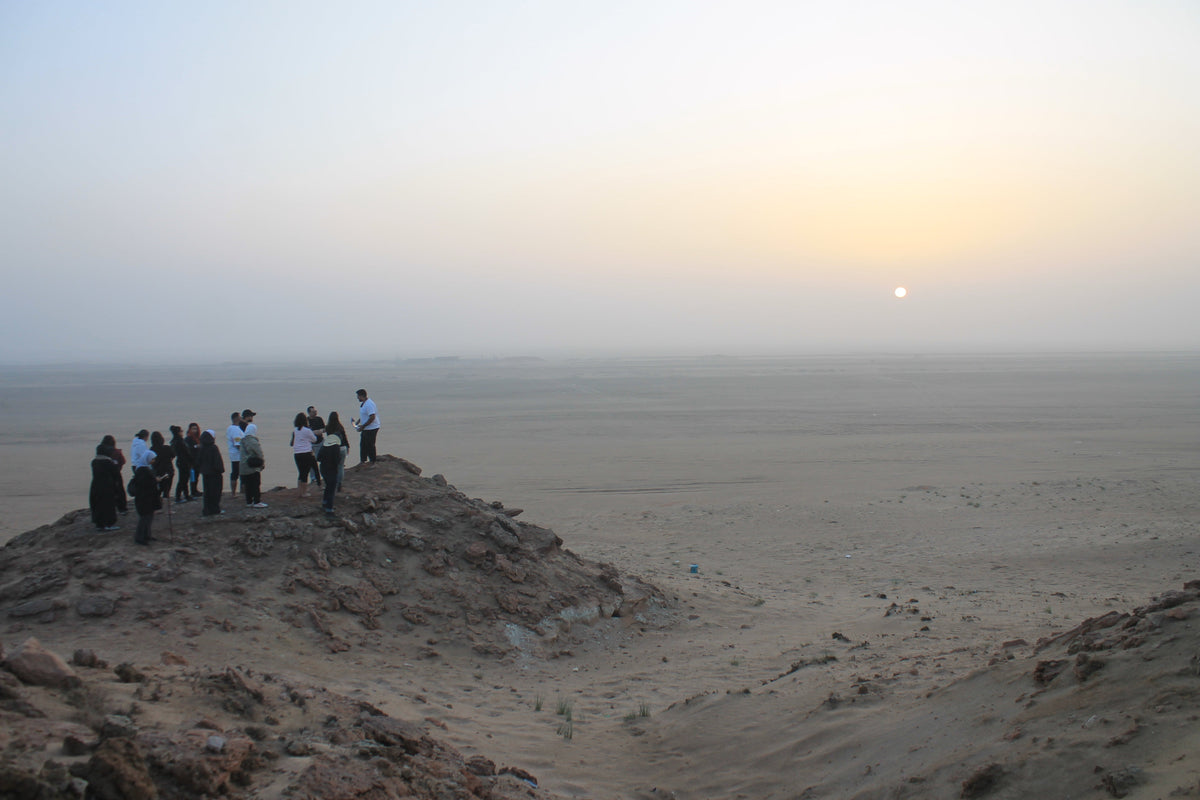
Following lost rivers, mysterious signals, ancient travellers, and the occasional question from outer space.
By Mohammed Bin Hasan
Founder of AlMaknoon Retreats
Independent Field Explorer & Researcher
I have a habit of asking questions that usually end with me somewhere in the desert.
Where did the water go?
Why is this patch of earth red?
Could an ancient river have crossed this landscape?
What really happened behind those strange UFO stories? And if a suspicious-looking rock catches my attention, could it possibly be a meteorite?
Most of the time, one question leads to another. Before I know it, I’m looking through old maps, reading research papers, comparing satellite imagery, or driving into the desert to see whether the landscape agrees with the story.
That’s how many of my explorations begin.
Not with a destination, but with a mystery.
I’m Mohammed Bin Hasan, the founder of AlMaknoon Retreats. My background is in electrical engineering, but my curiosity has never stayed within the boundaries of one discipline.
I’m drawn to ancient waterways, unusual geological formations, forgotten historical routes, meteorites, astronomy, and the strange stories people tell about places.
I don’t claim to have all the answers. In fact, the unanswered questions are often the most interesting part.
A legend might lead me to an old newspaper. A historical reference might send me searching through maps. A geological feature might make me rethink what I thought I knew about Kuwait.
Some stories survive investigation. Others become even more mysterious. And occasionally, the evidence tells a completely different story.
That is what makes exploration exciting.
Through AlMaknoon, I wanted to turn this curiosity into something we could experience together, visiting places and learning to read them.
Because Kuwait is far more interesting than it first appears.
Beyond the city are red landscapes, ancient islands, desert ridges, seasonal ecosystems, lost-waterway questions, mysterious communications stories, and skies that connect us to a much larger universe.
I’ve brought together nine of these experiences in this Field Notes collection.
Each begins with a question. Each takes us somewhere different. And each reminds us that exploration doesn’t always require travelling to the other side of the world.
Sometimes, it begins just beyond the next desert road.
Welcome to my field notes. Let’s see what Kuwait has been hiding.
Nine landscapes. Nine questions.
1. Redland of Al-Ubaid: The Red Earth Archive
Why is this desert red? Northern Kuwait’s coloured sediments and exposed layers invite questions about geology, erosion and the wider prehistoric Gulf. We walk the terrain, look for signs of wildlife and learn to separate what the land reveals from what still needs research.
2. Jabal Kathma: Land of Travellers
Before GPS, how did travellers find their way? We explore Kazima’s historical and poetic memory, climb the ridge and try our own mapmaking challenge, reading landmarks and directions from the ground itself.
3. Om Al-Aish: The Lost Signal
A communications landscape, stories of mysterious lights and reports of UFOs: Om Al-Aish feels like the beginning of a science-fiction mystery. In a clue-based team investigation, we explore the difference between archival evidence, rumours and an irresistible story. No alien encounters promised.
4. Subiya Bay: Where Desert Meets Sea
What happens when desert meets tidal water? Along Kuwait’s northern coast we examine shorelines, sediments and wildlife habitats, and consider the surprising connections between geography and life.
5. Failaka: Island of Many Civilizations
How many histories can one island hold? Failaka connects archaeological remains, maritime movement and memories of communities across different eras, from Bronze Age connections to later Hellenistic history and modern island life.
6. Boubyan: Island of Tides and Wings
A quiet-looking island can be full of movement. Boubyan’s tidal flats and shallow coastal habitats help us understand birds, seasonal migration and the ecological importance of the northern Gulf.
7. The Edenic River: Searching for Lost Water
Could today’s dry terrain preserve evidence of ancient drainage? We follow maps, landforms and scientific hypotheses about water and climate in Arabia, without confusing a compelling possibility with a proven river at our exact stop.
8. The Green South: When the Desert Awakens
After the right rains, a desert can change almost overnight. Seasonal plants and changing colours reveal how soil, water and life respond to brief opportunities in an arid climate.

9. 29° North: The Sky Above Kuwait
What if the next landscape is overhead? We look to the Moon, planets, stars and occasional meteors, exploring how skywatching combines observation, science and the myths humans have told about the universe.

Explore what is hidden
Kuwait is not a landscape we have finished exploring. It is one we are only beginning to understand. This article opens a series of AlMaknoon Field Notes, where each destination will receive a deeper investigation into its history, geology, ecology and the experience we build around it. Join us for the questions, the fieldwork and the discoveries still ahead.
Share: